
Crate South Education · Memphis, Tennessee
From AI curiosityto useful, governedsystems.
Crate South Education helps learners and organizations understand how AI becomes a real workflow, product, or operating capability — not just a chatbot conversation.
- 0
- stages in the system map
- 0
- public use cases
- 0
- modular programs
- 0
- method, taught openly
The learning journey
live map
Why this exists
Knowing how to chat with a model is not the same as knowing how to build with one.
01
Shallow literacy
Most AI education stops at prompting tips and tool tours. Learners leave able to talk about AI — but not to design, question, or operate anything with it.
02
What work actually needs
Organizations need people who can map a workflow, place AI inside it carefully, keep humans accountable, measure results, and say what the system must never do.
03
What we teach
Applied AI as a systems discipline: problem first, people always, workflow before tools, approvals before actions, evidence before claims. Learners build real maps and real prototypes.
One Tuesday in North Memphis
2:41 PM
The phone rings.
A new customer, ready to book a full detail. A hundred fifty dollars, maybe more — calling the shop they drove past yesterday.
A composite illustration of the missed-call use case we teach — not a client result.
The learning journey
01 / 11
Problem
Name the real pain before any tool enters the room.
- Problem
- Context
- Workflow
- Data
- Intelligence
- Decision
- Human Approval
- Action
- Evidence
- Learning
- Improvement
Programs
Five programs, one method.
From a 90-minute introduction to multi-week cohorts and train-the-trainer, every program teaches the same discipline: map the system, keep humans in charge, measure honestly.
Something custom?
Programs can be tailored to your learners, schedule, and goals — from a single guest talk to a designed curriculum.
Discuss a workshop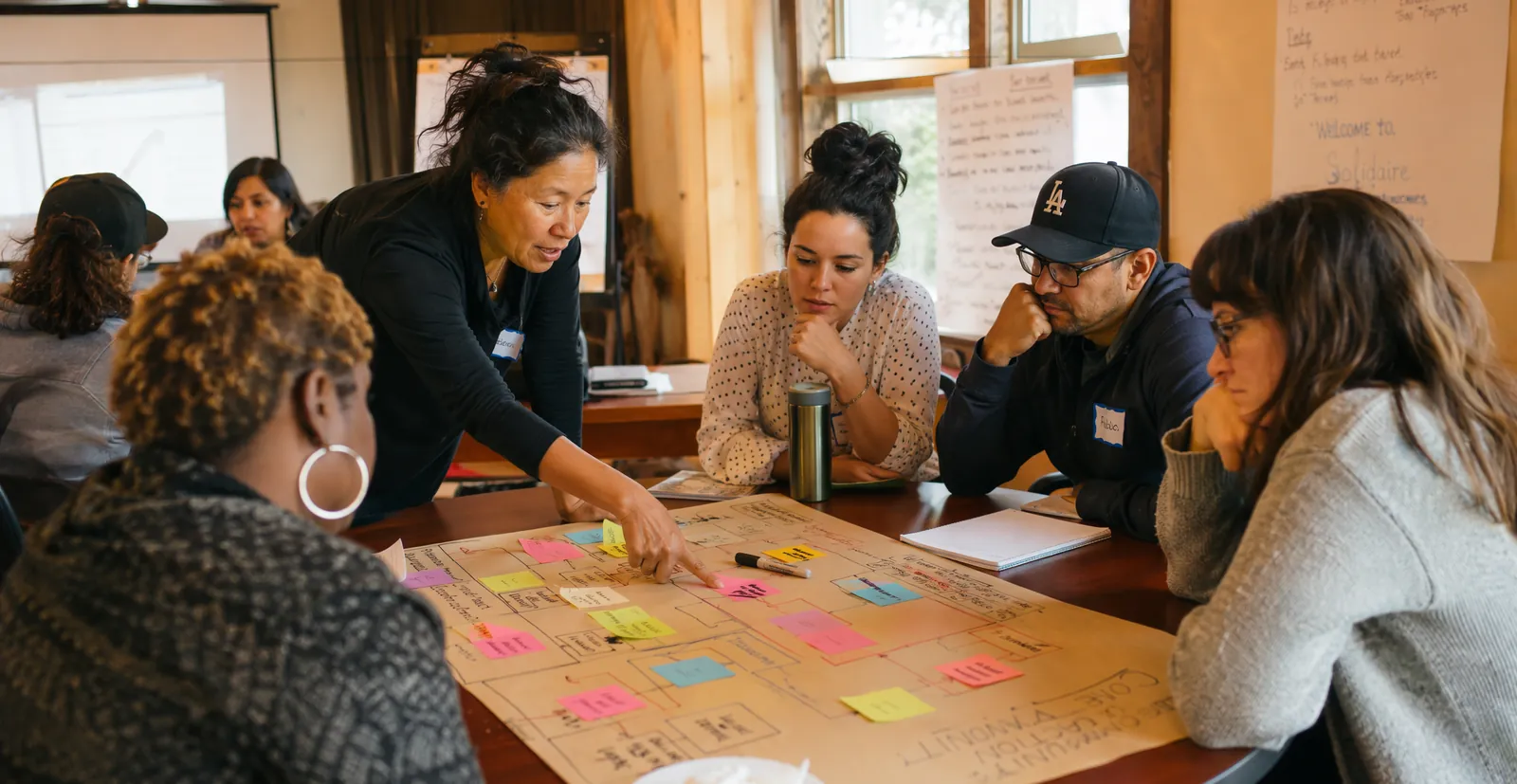
In the room
The method is taught live — paper on the table, real problems, real maps.
Every workshop ends with something a participant built and can explain — not a certificate for watching slides.
Who this serves
Built for the whole community, not one audience.
The philosophy
Most people will rent this technology.
We teach our community to own it.
Own the map. Own the workflow. Own the evidence. Capability that stays in the neighborhood becomes wealth that stays in the neighborhood. That is why we teach systems instead of prompts — prompts make you a customer; systems make you an owner.
- Own the map
- If you can draw how the work flows, no vendor can sell you mystery.
- Own the judgment
- Approvals, boundaries, and the never-list belong to people — always.
- Own the evidence
- Your records, your baselines, your proof. Results you can show.
The moment
Memphis is becoming an AI education city — and this is home turf.
This year, Anthropic committed $1 million to Memphis-based CodeCrew to expand AI instruction — tripling its instructional capacity and anchoring a new national headquarters at Northside Square in North Memphis. Over the past decade, CodeCrew has trained more than 16,000 Memphians in computer science and AI. WREG News
Corey lives minutes from Northside Square. He has reached out to CodeCrew about volunteering his time — and either way, every material on this site is already free for any Memphis educator, parent, or program to use. The capability should belong to the neighborhood it serves.
Crate South Education is an independent practice — not a grantee or partner of Anthropic or CodeCrew. We cite their news because it raises the tide, and because our work is built to add value to it.
- $1M
- committed by Anthropic to CodeCrew for AI instruction
- 16,000+
- Memphians trained in CS & AI over the past decade
- 3×
- instructional capacity the gift unlocks
- 5,000
- city workforce-pathway goal by 2030, per the Mayor
Proof of work
Taught from practice, not from slides about practice.
Crate South Education is built by Corey Ealy, a founder and systems architect who designs and operates AI-assisted ventures and workflows. The curriculum draws on real categories of work — shared as public educational abstractions, never as proprietary disclosure.
Case studies, pilot outcomes, and partner references will be published here as real work completes — labeled honestly, never invented. More about Corey
Free field guide
From Prompt to System
A practical guide to building useful AI workflows.
Sixteen chapters of method — no padding, no hype — with worksheets, checklists, a one-page system canvas, and four public use cases. Practical enough to teach from directly.
Inside the guide
- 01Why prompting is only the beginning
- 02Map the workflow before choosing tools
- 03What AI should and should not do
- 04Human-in-the-loop design
- 05Boundaries and failure conditions
- 06Measuring usefulness and cost
- 07Four public use cases, end to end
- 08A one-page system canvas + build worksheet
Start a conversation.
Tell us who you teach, serve, or employ — and what you want AI to actually do for them. We will respond with an honest read on fit and next steps.